Assessing Design and Deployment Strategies for Future Microwave-Sounding Missions
July 24, 2026 02:34 PM

Monthly Weather Review vol. 154, issue 4
© AMS
CISESS Scientist Dr. Zaizhong Ma and co-authors, including CISESS Deputy Director Dr. Hugo Berbery, recently published a study on the expected forecast impact of future microwave sounding instruments planned under NOAA’s Near Earth Orbit Network (NEON) program using the Ensemble of Data Assimilations (EDA)within the European Centre for Medium-Range Weather Forecasts (ECMWF) Integrated Forecasting System.The work was carried out in close collaboration with colleagues from the ECMWF Microwave Team.
In this study, two observing system concepts are assessed. The first examines the benefit of deploying an Advanced Technology Microwave Sounder (ATMS)-like instrument in the early morning (1730 LTAN) orbit to complement existing mid-morning and afternoon satellites. The second evaluates the more advanced Sounder for Microwave-Based Applications (SMBA), which includes additional channels near 118 and 229 GHz, in both 1330 LTAN and 1730 LTAN orbital configurations. The results show that an ATMS-like instrument in the early morning orbit significantly reduces short-range forecast uncertainty, with an impact comparable to that of legacy POES satellites.
The additional 118- and 229-GHz channels on SMBA provide modest but measurable improvements in forecasts of geopotential height and wind fields beyond those achieved with the conventional 50- and 183-GHz channels alone. However, these new channels complement rather than replace the essential 50-GHz temperature sounding band. The greatest forecast benefit is achieved with a two-orbit SMBA constellation. Across all experiments, forecast impact is found to be highly sensitive to instrument noise, highlighting the importance of low-noise sensor design. Comparisons between real and simulated ATMS observations further demonstrate consistent impact estimates, increasing confidence in the simulation-based assessment.
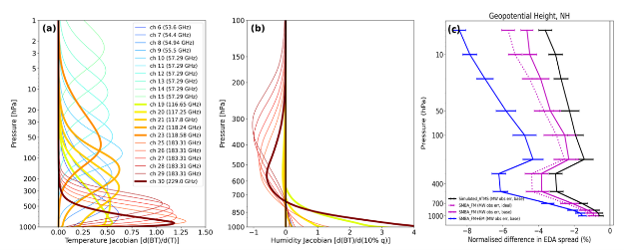
Figure 1: Temperature (a) and humidity (b) Jacobians for SMBA in clear-sky conditions, with new 118 GHz and 229 GHz channels. (c) Vertical profiles of EDA spread reduction for geopotential height in northern hemisphere (latitude > 20°N). The baseline observing system, which used as proxy for a future observing system without NOAA MW sounders, includes all non-MW observations used operationally at ECMWF in 2021, excluding passive MW data from China. Data are for the period 8-30 June 2021 and error bars indicate an estimate of 95% confidence.
Citation: Ma, Zaizhong, Niels Bormann, Katie Lean, David Duncan, Ernesto Hugo Berbery, and Satya Kalluri, 2026: Ensemble of Data Assimilations (EDA) impact studies in support of NOAA’s Next-Generation Microwave Sounding Missions. Mon. Wea. Rev., 154, 687–702, https://doi.org/10.1175/MWR-D-25-0255.1.
« Back