The 2025 Global Carbon Budget
August 14, 2026 09:54 AM
Earth System Science Data
© Copernicus Publications
By Maureen Cribb
CISESS Scientist Annika Jersild and other members of the international carbon cycle research community present a “living data” update on the global carbon budget, the 14th such update published in the journal Earth System Science Data. The authors provide a comprehensive description and synthesis of datasets and methodologies quantifying the five major components of the global carbon budget: fossil carbon dioxide (CO2) emissions, land-use change, global atmospheric CO2 growth rate, global net uptake of CO2 by the ocean, and global net uptake of CO2 by the land. Their analysis focuses on the industrial period (1750 to 2025) and the recent period since 1959. The overall picture shows that compared to 2024, global fossil CO2 emissions in 2025 are projected to increase by 1%, with emissions from coal, oil, and gas all above their previous year levels.
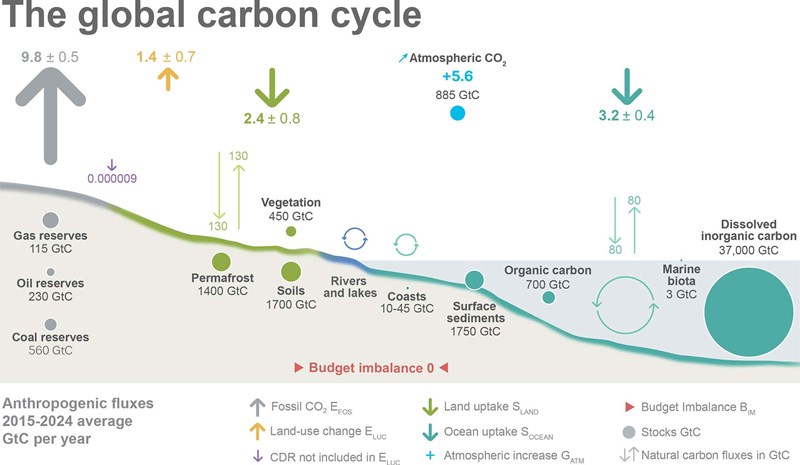
Figure 1. Schematic representation of the overall perturbation of the global carbon cycle caused by anthropogenic activities, averaged globally for the decade 2015–2024. Fluxes estimates are shown with their 1 standard deviation uncertainty. The carbon dioxide removal (CDR) estimate is for the year 2024. Fluxes are in GtC yr-1 and reservoirs in GtC. This figure was produced by Nigel Hawtin.
Over the 2014–2024 period, Brazil, Indonesia, and the Democratic Republic of Congo were responsible for more than half of global land-use CO2 emissions, mainly via deforestation. Based on new process understanding, the global net uptake of CO2 by the ocean has taken up 29% of the total emissions in the past decade. Also, the land sink (excluding land use) has taken up 21% of the total emissions during the same period. This kind of annual update is essential to meet the demand for the most current information on how anthropogenic activities are changing the climate system and the underlying mechanisms behind it all. Jersild’s CISESS Project is funded by the NOAA Global Ocean Monitoring and Observing program (GOMO).
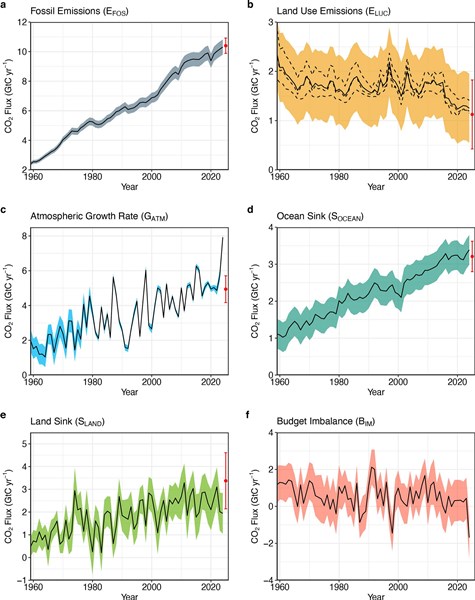
Figure 2: Components of the global carbon budget and their uncertainties as a function of time for (a) fossil CO2, (b) emissions from land-use change, (c) growth rate in atmospheric CO2 concentration, (d) the ocean CO2 sink, (e) the land CO2 sink, and (f) the budget imbalance, defined as the sum of all sources and sinks and a measure of the mismatch between the estimated total emissions and the estimated changes in the atmosphere, land, and ocean reservoirs. All data are in GtC yr-1 with the uncertainty bounds representing ±1 standard deviation (colored shaded areas). The red dots indicate the authors’ projections for the year 2025, and the red error bars show uncertainties in the 2025 projections.
Citation: Friedlingstein, Pierre, Michael O’Sullivan, Matthew W. Jones, Robbie M. Andrew, Dorothee C. E. Bakker, Judith Hauck, Peter Landschützer, Corinne Le Quéré, Hongmei Li, Ingrid T. Luijkx, Glen P. Peters, Wouter Peters, Julia Pongratz, Clemens Schwingshackl, Stephen Sitch, Josep G. Canadell, Philippe Ciais, Kjetil Aas, Simone R. Alin, Peter Anthoni, Leticia Barbero, Nicholas R. Bates, Nicolas Bellouin, Alice Benoit-Cattin, Carla F. Berghoff, Raffaele Bernardello, Laurent Bopp, Ida Bagus Mandhara Brasika, Matthew A. Chamberlain, Naveen Chandra, Frédéric Chevallier, Louise P. Chini, Nathan O. Collier, Thomas H. Colligan, Margot Cronin, Laique M. Djeutchouang, Xinyu Dou, Matt P. Enright, Kazutaka Enyo, Michael Erb, Wiley Evans, Richard A. Feely, Liang Feng, Daniel J. Ford, Adrianna Foster, Filippa Fransner, Thomas Gasser, Marion Gehlen, Thanos Gkritzalis, Jefferson Goncalves De Souza, Giacomo Grassi, Luke Gregor, Nicolas Gruber, Bertrand Guenet, Özgür Gürses, Kirsty Harrington, Ian Harris, Jens Heinke, George C. Hurtt, Yosuke Iida, Tatiana Ilyina, Akihiko Ito, Andrew R. Jacobson, Atul K. Jain, Tereza Jarníková, Annika Jersild, Fei Jiang, Steve D. Jones, Etsushi Kato, Ralph F. Keeling, Kees Klein Goldewijk, Jürgen Knauer, Yawen Kong, Jan Ivar Korsbakken, Charles Koven, Taro Kunimitsu, Xin Lan, Junjie Liu, Zhiqiang Liu, Zhu Liu, Claire Lo Monaco, Lei Ma, Gregg Marland, Patrick C. McGuire, Galen A. McKinley, Joe R. Melton, Natalie Monacci, Erwan Monier, Eric J. Morgan, David R. Munro, Jens D. Müller, Shin-Ichiro Nakaoka, Lorna R. Nayagam, Yosuke Niwa, Tobias Nutzel, Are Olsen, Abdirahman M. Omar, Naiqing Pan, Sudhanshu Pandey, Denis Pierrot, Zhangcai Qin, Pierre Regnier, Gregor Rehder, Laure Resplandy, Alizée Roobaert, Thais M. Rosan, Christian Rödenbeck, Jörg Schwinger, Ingunn Skjelvan, T. Luke Smallman, Victoria Spada, Mohanan G. Sreeush, Qing Sun, Adrienne J. Sutton, Colm Sweeney, Didier Swingedouw, Roland Séférian, Shintaro Takao, Hiroaki Tatebe, Hanqin Tian, Xiangjun Tian, Bronte Tilbrook, Hiroyuki Tsujino, Francesco Tubiello, Erik van Ooijen, Guido R. van der Werf, Sebastiaan J. van de Velde, Anthony P. Walker, Rik Wanninkhof, Xiaojuan Yang, Wenping Yuan, Xu Yue, and Jiye Zeng, 2026: Global Carbon Budget 2025. Earth Syst. Sci. Data, 18(5), 3211–3288, https://doi.org/10.5194/essd-18-3211-2026.
« Back