The Network for Detection of Atmospheric Composition Change
July 31, 2026 10:56 AM
Network for Detection of Atmospheric Composition Change
© © NDACC
CISESS Scientist Jeannette Wild (retired) co-authored a new article in the journal Atmospheric Chemistry and Physics on the Network for Detection of Atmospheric Composition Change (NDACC). NDACC was established in 1991, expanding from the original Network for Detection of Stratospheric Change to include ground-based measurements of atmospheric chemical species and parameters in the troposphere and the mesosphere. De Mazière et al. (2018) provides a history of this global observing system, noting that NDACC must continuously update its capabilities to meet evolving data needs.
A summary of the observations NDAAC collects is shown in Figure 1 below:
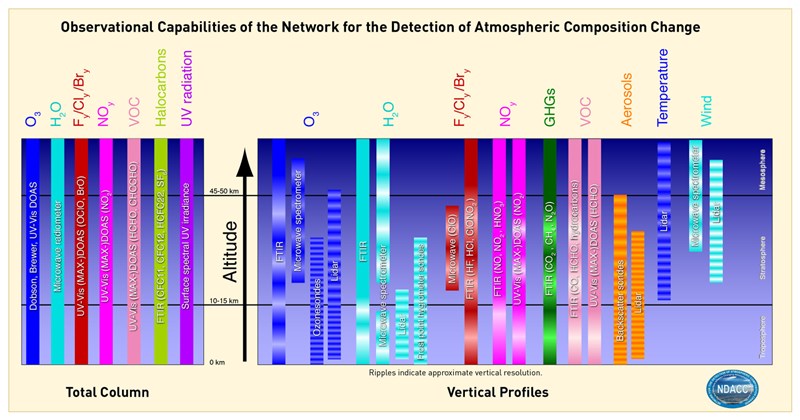
Figure 1: Chart of NDACC observational capabilities color-coded by observed atmospheric species and parameters with chemical formulas listed at the top. The altitude range of profiles illustrates the approximate vertical resolution associated with each measurement technique (light horizontal stripes on vertical columns). The two horizontal black lines show the approximate levels of the tropopause and the stratopause. The ripples indicate approximate vertical resolution.
The article highlights NDACC scientific achievements in the stratosphere and troposphere, including:
-
Stratospheric ozone trends;
-
Ozone-depleting substances, halogenated stratospheric reservoir species, and stratospheric circulation;
-
Water vapor observations in the stratosphere;
-
Hunga volcanic eruption;
-
Extreme Australian wildfires and stratospheric chemistry;
-
Tropospheric ozone assessment
-
Long-term trends in whole atmosphere carbonyl sulfide; and
-
Surface UV radiation.
Based on their detailed review of current challenges facing this network, they offer a three-pronged strategy for the future: protecting existing stations and data streams; promoting greater usage of NDACC data; and expanding NDACC’s coverage geographically and in the species-parameter space.
See the article for more information.
Citation: Petropavlovskikh, Irina, Martine De Mazière, Anne M. Thompson, Jeannette D. Wild, James W. Hannigan, Henry B. Selkirk, Reem A. Hannun, Wolfgang Steinbrecht, Jean-Christopher Lambert, Roeland Van Malderen, Elizabeth Asher, Raul R. Cordero, Sophie Godin-Beekmann, Daan Hubert, Sergey Khaykin, Karin Kreher, Thierry Leblanc, Emmanuel Mahieu, Eliane Maillard Barras, Glen McConville, Gerald Nedoluha, Ivan Ortega, Alberto Redondas Marrero, Gunther Seckmeyer, Ryan M. Stauffer, Sarah A. Strode, Kim Strong, Takafumi Sugita, Michel Van Roozendael, Voltaire Velazco, Corinne Vigouroux, and Baerbel Vogel, 2026: Overview: The Network for the Detection of Atmospheric Composition Change at 35 years: achievements and future strategy. Atmos. Chem. Phys., 26, 8637–8675, https://doi.org/10.5194/acp-26-8637-2026.
« Back