New Chemistry for the Unified Forecasting System
March 30, 2026 11:28 AM
Journal of Advances in Modeling Earth Systems
© AGU
By Maureen Cribb, CISESS Coordinator
The Unified Forecasting System (UFS) is a suite of numerical models developed by the science community to support weather, smoke, and air quality prediction at NOAA. Currently, the U.S. Environmental Protection Agency’s Community Multiscale Air Quality model and the Goddard Chemistry Aerosol Radiation and Transport model are incorporated into the UFS, providing some atmospheric chemistry information for air quality forecasts. However, having different chemistry-related code from different models complicates things within the UFS. Creating a generalized global configuration of the official UFS to better simulate full tropospheric and stratospheric chemistry needed for global air quality applications would be beneficial.
CISESS Scientists Kai Yang, Zachary Moon and colleagues aimed to do just that, describing how they went about it in their paper published in the Journal of Advances in Modeling Earth Systems. They developed the Configurable ATmospheric Chemistry (CATChem) library and modeling component that includes comprehensive chemical and aerosol processes from NOAA’s Geophysical Fluid Dynamics Laboratory’s Atmosphere Model version 4.1. UFS‐Chem v1.0 was thus born.
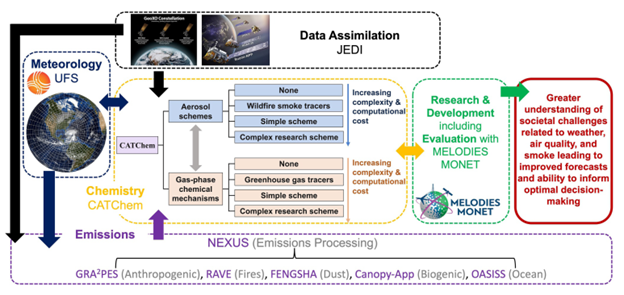
Figure: The conceptual framework of UFS‐Chem.
Simulations of various atmospheric gases using this new UFS were validated against a whole slew of observations including:
-
Satelite instrument retrievals from the the Ozone Mapping and Profiler Suite (OMPS) on the JPSS satellites, Measurement of Pollution in the Troposphere (MOPITT) instrument on the Terra satellite, and the Ozone Monitoring Instrument (OMI) on the Aura satellite;
-
Ozonesonde data from the World Ozone and Ultraviolet Radiation Data Centre (WOUDC);
-
Aircraft measurements from the NASA Atmospheric Tomography Mission (ATom); and
-
Surface observations from the Tropospheric Ozone Assessment Report (TOAR) from theInternational Global Atmospheric Chemistry (IGAC) Project.
The authors report that overall, UFS-Chem does a reasonable job of simulating observations and captures well the spatiotemporal distributions of different atmospheric gases. They note some issues with the UFS-Chem, for example, its coarse resolution does not capture fine-scale changes in primary pollutants in urban areas, which they plan on tackling in future work.
Citation: He, Jian, Li Zhang, Rebecca H. Schwantes, Barry D. Baker, Larry Wayne Horowitz, Vaishali Naik, Congmeng Lyu, Zachary Moon, Georg A. A. Grell, Ravan Ahmadov, Jordan Schnell, Kai Yang, Zigang Wei, Siyuan Wang, Kai-Lan Chang, Alan M. Gorchov Negron, Aihua Zhu, Shobha Kondragunta, Eric C Apel, Ilann Bourgeois, Roisin Commane, Samuel R Hall, Alan J. Hills, Rebecca S. Hornbrook, Jeff Peischl, Kirk Ullmann, Gonzalo Gonzalez Abad, Zolal Ayazpour, Caroline R. Nowlan, and Brian McDonald, 2025: Incorporating gas-phase chemistry into the Unified Forecast System (UFS) for global air quality applications. J. Adv. Model. Earth Syst., 18(3), e2025MS005299, https://doi.org/10.1029/2025MS005299 .
« Back