The New Radar Module for the Community Radiative Transfer Model
February 27, 2026 11:49 AM
Atmospheric Measurement Techniques
© AMT
by Maureen Cribb, CISESS Coordinator
In their paper published in Atmospheric Measurement Techniques, CISESS Scientist Isaac Moradi and coauthors at NOAA and NASA examine how well the Community Radiative Transfer Model (CRTM) performs for different radar frequencies now that a radar module is included in this RTM. The CRTM is commonly used in the assimilation of satellite observations within numerical weather prediction (NWP) systems. This article comes from Moradi's JPSS PGRR-funded CISESS project on EarthCARE Cloud Profiling Radar (CPR). EarthCARE CPR, Global Precipitation Measurement Dual-Frequency Precipitation Radar, and CloudSat CPR observations were used in their analyses for this article. The authors focused on the sensitivity of different frequencies to hydrometeor type and the impact of particle size distributions (PSDs) and hydrometeor shape assumptions on simulated radar reflectivities. They show that overall, the choice of PSD and particle shape, especially snow particle habits, largely influence simulated reflectivities. They plan to cover more hydrometeor types like hail and graupel in future analyses and to determine observation errors for the assimilation of spaceborne radar observations in NWP models.
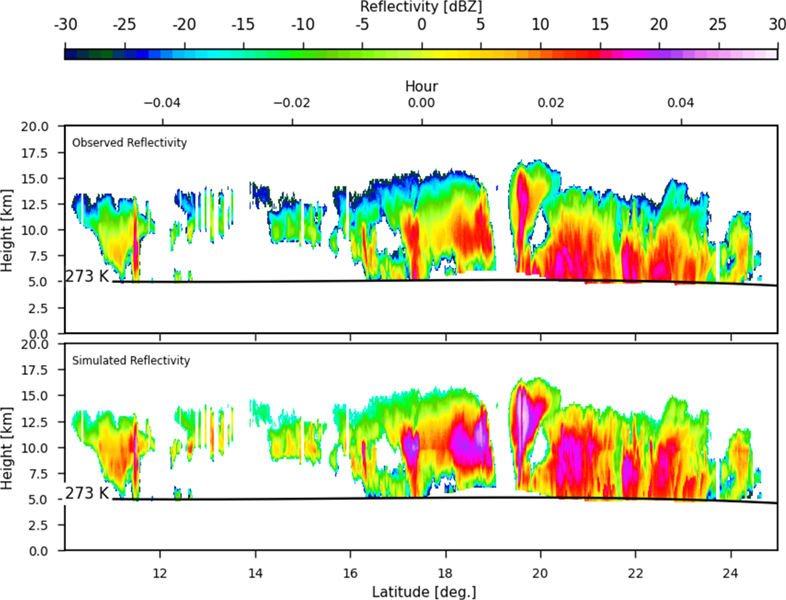
Figure: Observed (top panel) and simulated (bottom panel) CloudSat CPR reflectivities for Hurricane Bill on 19 August 2009 at 17:19 UTC.
Moradi, Isaac, Satya Kalluri, and Yanqiu Zhu, 2026: Forward modeling of spaceborne radar observations. Atmos. Meas. Tech., 19, 549–563, https://doi.org/10.5194/amt-19-549-2026.
« Back